
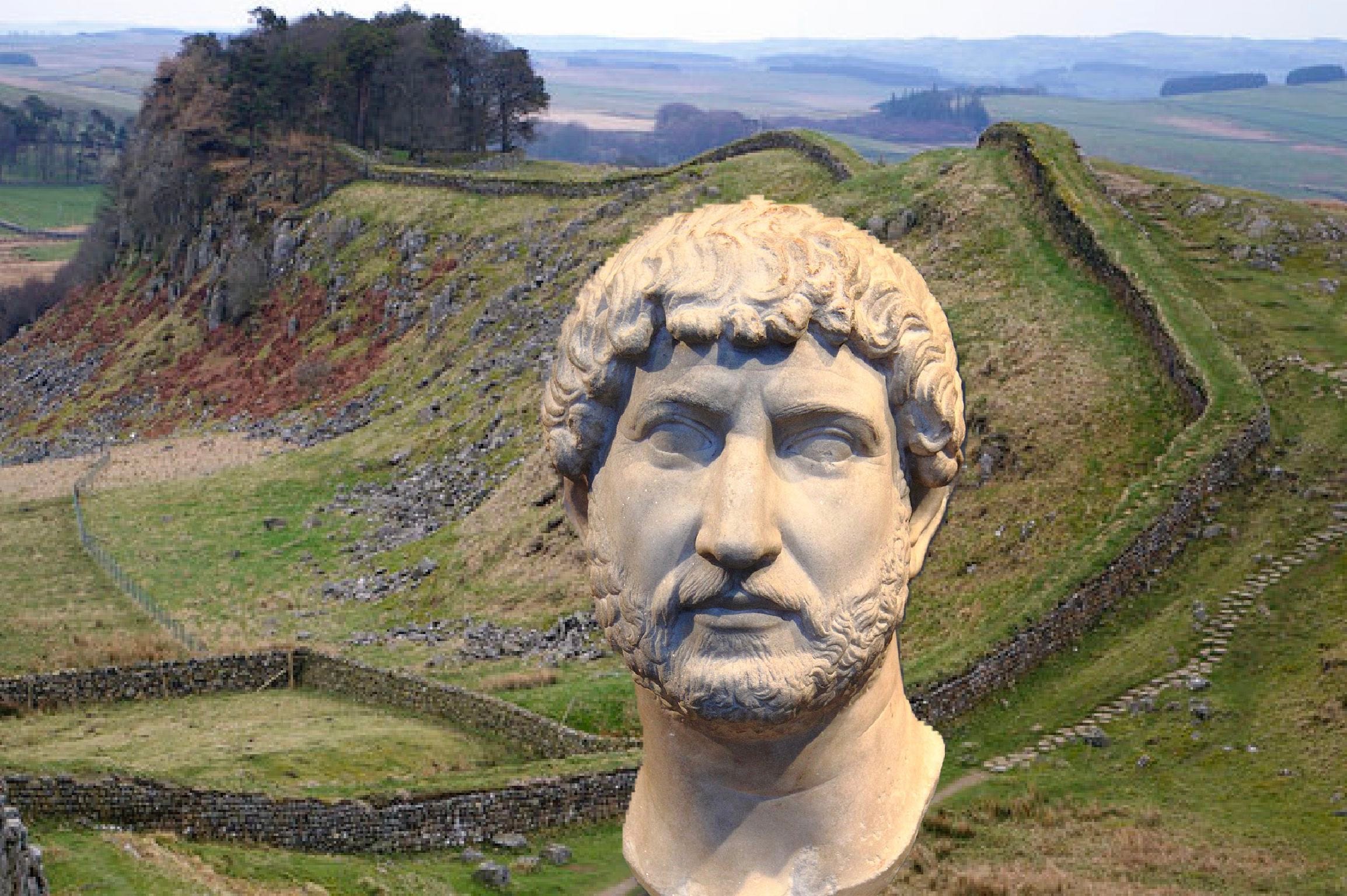
Hadrian’s Wall is the largest monument the Romans left behind in Britain, and it lies on the furthest-flung frontier of their Empire.
It was also a gigantic mistake.
No other building in Britain approaches its vast scale: running for a total of seventy-three miles from the River Tyne to the Solway Firth and another fifty miles down the Cumbrian coast. It took 15,000 men six years to build.
The Emperor Hadrian took the momentous decision in around 122 AD to halt the growth of the Empire and build Rome’s greatest borderline. When he came to power the empire had been expanding for hundreds of years. The Roman army was stretched beyond its limit and as a result the empire was beset with rebellions and struggling to hold onto ever further-flung provinces. Hadrian therefore decided to implement a policy of security and stability by freezing the empire's existing boundaries.
As historian Cornelius Fronto wrote forty years later to the emperor Marcus Aurelius, holding down Britannia in Hadrian’s time had become extremely costly in terms of Roman lives:“... under the rule of your grandfather Hadrian what a number of soldiers were killed by …the Britons” .
The main potential enemy the Romans faced were the Brigantes who had dominated the place we now know as Cumbria and the north of England for at least 400 years before the Roman invasion. As the discovery of 800 pieces of Brigantian treasure known as the Melsonby Hoard in 2021 showed, the Brigantes were formidable. They were wealthy, superbly well equipped, armed with war chariots, they enjoyed close contacts with Continental weapons suppliers and they vastly outnumbered the Romans.
Soon after the invasion, the Romans cautiously opted to ally with the Brigantes rather than fight them. They paid the Brigantian Queen, Cartimandua, with gold to act as a proxy ruling the north of Britannia on Rome’s behalf for 26 years. Then, in 69 AD, the greedy queen was deposed for being too compliant to the invaders by the husband she divorced, Venutius. He was outraged when she took up with Vellocatus, who had been Venutius’ armour-bearer.
In the fifty years between Cartimandua’s deposition and Hadrian’s visit, the north was riven by repeated disturbances, guerrilla action and resistance across Brigantian territory. Attempts by the invaders to Romanise the Cumbrian Celts applied nothing more than a surface veneer on a boiling reservoir of resentment. The local Celts spurned Roman influences and continued to live according to their native culture, largely refusing to collaborate with imperial authorities.
Evidence of Roman goods making it into Celtic dwellings is paltry. This suggests that Rome quickly gave up trying to win the hearts and minds of the Cumbrians. Instead, they resorted to subduing them with violence, repressive measures and frequent battles. As a result, Roman authority in the first century of occupation remained limited to garrisons and the civilian vici settlements next to forts.
Cumbria, in other words, became Rome’s Afghanistan. The locals fought back against repression, hard. Ultimately, the Romans were compelled to deploy a massive border force to patrol Britannia. Roughly 15 per cent of the entire worldwide Roman army ended up being stationed in Britain at its peak, with the vast majority of those troops posted on the northern border, the largest contingent of soldiers anywhere in the Empire. Yet it still could not control the local population.
The vast wall that Hadrian designed to meet this emergency (he fancied himself as an architect) would be manned by upwards of nine thousand soldiers for three hundred years. Officially, it was created, in Hadrian’s words, to “separate Romans from the barbarians” and stop the ferocious Caledonians from making common cause with dissident tribes, particularly the Brigantes, in the centre of the island.
But there were conceptual problems. The jobs Hadrian wanted the wall to do were contradictory. It must defend the frontier, he said, but allow natives to cross to and fro; it must tie up troops collecting taxes at up to 80 gates while keeping a sharp lookout for rebel raids; it must respond forcefully to attacks but ensure limited forces are spread evenly along its entire 73-mile length.
Hadrian also wanted the wall to make a psychological impact. His version of the Maginot Line was to be a static, whitewashed, visible statement of the invincibility of the Roman state that, he hoped, would intimidate the enemy into acquiescence while also acting as a conspicuous monument to his own greatness.
His design for the wall was full of absurdities that went well beyond quotidian practicality. Hadrian was notorious for his personal showmanship, love of display, and a tendency toward grandstanding that was frequently mocked even in antiquity. For example, he built 25,000-seat amphitheatre in his home town of Italica which had a population of only about 8,000 people at the time. With his wall, Hadrian invested much faith in the power of spectacle and not much in tried and tested military thinking.
Given how much he was spending, Hadrian’s new wall needed to be highly effective. But his design must have made his commanders tear their hair out. For instance, Hadrian inflexibly ordered that 80 milecastles be constructed at evenly spaced points along the wall each housing 30 soldiers. This meant milecastles had to be built in stupid places such as on slopes where troops could not easily get in and out. For example, milecastles 35, 36, and 37 on Hadrian’s Wall are positioned dramatically on or near steep crags, while milecastles 33 and 34 opened onto bogs.
Even where Hadrian’s wall ran over on level ground, gateways often opened onto awkward drops. There are many signs that builders tried to make adjustments while construction was under way. But the illogical demands Hadrian’s design imposed on them made the wall vulnerable at many points.
Hadrian demanded 160 watchtower turrets be spaced a third of a Roman mile apart along the wall, each housing eight soldiers. They were abandoned, demolished and robbed of their stone shortly afterwards in 142. The reason? Well, if hostile troops came close enough to be seen from the watchtowers, it was already too late.
But the biggest problem was not the way it was constructed - it was the flawed military thinking behind it. Hadrian’s commanders disliked the wall because a fixed barrier contradicted hundreds of years Roman military doctrine. The Empire had been built by armies that deliberately avoided fixed positions, fought in the open and took advantage of maximum manoeuvrability on the battlefield.
So, given that the wall had to be operated by thousands of troops who had been trained to do things entirely differently, how did it perform? The truth is the elaborate structure, with its imposing stone masonry fifteen feet high and ten feet wide, failed. It was overrun several times by the northern barbarians.
The wall was overwhelmed, for example, in 180 AD, 196, 296 and then in 367 came a catastrophic invasion known as the Great Barbarian Conspiracy. This apparently co-ordinated attack by Saxons, Picts, Scoti, and Attacotti, who may have been Irish, threw the whole province into turmoil. Roman Britain never fully recovered and the flaws it laid bare in organisation and leadership foreshadowed the collapse of the entire Empire.
So, Hadrian’s scheme did not separate the barbarians from each other and it did not secure the peace and prosperity of a Romanised Britain. The wall was not even able to persuade most Cumbrians that there were benefits in Roman domination.
The best evidence we have of what Roman top brass officers thought of the wall is the complete absence in the historical and archaeological record of any written endorsement from Roman field commanders for the strategy of the fixed barrier. Also, within two decades of the wall going up, commanders and policy-makers reverted to previous strategies of mounting a defence well north of the wall, essentially ignoring its existence. Then they defied Hadrian’s ban on expanding the boundaries of the Empire by creating the short-lived Antonine wall 100 miles to the north.
The precise reason why things went awry on Hadrian’s Wall is not immediately obvious. Some modern military experts say there was nothing wrong in principle with a physical barrier. In fact, they argue, Hadrian’s concept was brilliant. It could have worked if everyone involved had dropped the previous Roman military philosophy and scrupulously embraced the procedures necessary to make the new barrier effective. But they didn’t.
The flaws that brought wall’s failure were mainly human, the same ones that brought the entire Empire down.
Most people today are awed by the fame and monumentality of Hadrian’s Wall and many fail to believe military chiefs would have consented to the emperor building such a gigantic edifice if they were convinced it would not work. But that is a misunderstanding.
Hadrian possessed enormous decision-making power. He had adopted a very controversial non-expansionary world view that was totally different to any of his territorially aggressive predecessors. Despite the doubts of his officers, he was able to impose a fixed barrier on an army in defiance of conventional military doctrine. His subordinates knew Hadrian had bet his emperor ship on an unprecedented policy of fixed limits that marked a new era in Roman imperial thinking and security and heads would have rolled if anyone disagreed.
Hadrian’s tactical revolution meant that, once in operation, the army on Hadrian’s Wall needed to drop its normal routine. Most critically, for the wall to work, they needed very early warning of any attack from the north so commanders could deploy substantial force well in advance of the wall in open country. No competent commander could risk allowing hostile tribes to reach the wall itself because, despite its bulk it was impossible to gather enough troops in a hurry to stop a determined attack in a surprise location. Whenever rebels had reached the wall in the past, the wall had failed.
Of course, the irony is, by being compelled to send troops out well north of the wall to have any chance of success, the Romans would have done just as well if the wall had not existed.
The trouble with the wall was not just how Hadrian physically designed it. The deeper issue was the Romans’ entire attitude to conquering Britain. When the Emperor Claudius gave the order to invade Britain in 43 AD, he made the false assumption that a force of 40,000 legionaries, the most professional and highly trained soldiers Rome possessed, would be sufficient to conquer the entire island.
He assumed a rapid victory was possible with few troops because he had been told the inhabitants were unsophisticated and disunited barbarians. But Claudius’ bet was wrong. In a sense, Hadrian was attempting to rescue Roman Britain from the consequences of Claudius’ mistake. He thought that by introducing a massive fixed barrier he could make Claudius’ original vision of conquest on the cheap a reality. He was also wrong.
In fact, the Britons were not unsophisticated. They had a highly developed warrior culture. Their tradition of mobile warfare and well-practised tactic of creating temporary stockades embedded in woodland proved very difficult for the Roman military to overcome. This meant that even a force of 40,000 was inadequate to do the job and that number became increasingly insufficient the further north the Romans got, because cohorts had to be left behind to guard areas that had already been conquered. But the leadership back in Rome, thinking they had given the commanders all they needed, became impatient that the operation was taking too long when there were more important priorities on the Continental mainland.
The Roman historian Tacitus wrote a biography of his uncle, Ganaeus Julius Agricola, the general charged with completing the conquest of northern Britain. Agricola was furious when he found himself being withdrawn prematurely in 85 AD by the Emperor Domitian before the whole of the island had been conquered. Agricola believed it had been a serious error not to take it all when the Romans had the chance, Tacitus wrote. Leaving the Caledonians free to roam around had rendered the province permanently unstable.
Senior officers saw Hadrian’s solution to this instability - the fixed barrier - as a “monumental folly”, academics such as David Breeze have reported.
They argued Hadrian’s wall would be easily circumvented or breached, particularly by agile native raiders or larger forces. As a result the wall would require, not fewer troops, but more. They would have to mount a constant watch to prevent the wall being crossed. There would be costly maintenance bills and a need for extra supplies to feed a permanent garrison, which would tie down resources better used for field campaigns and rapid intervention elsewhere. A fixed barrier also meant that defenders would be outnumbered or poorly placed if an enemy appeared at an unexpected point, as reinforcements would have to travel considerable distances to react. The critics were right in every respect.
The natives were also far better armed than the Romans expected. The magnificent Embleton Sword found near Cockermouth, made in the La Tene style with intricate geometric decoration, is in fact a more sophisticated weapon than anything at that time in the Roman armoury.
The Romans were exasperated by the refusal of the Northern tribes to surrender and submit to enjoying the benefits of the Roman lifestyle with its public baths, towns and public entertainment. In the face of this stubbornness, the Romans decided the Carvetii tribe that occupied Cumbria were a different breed and needed to be treated more harshly. In the south, the flavour of the occupation was civilian. In the north, and particularly in Cumbria, the taste was military dictatorship.
So, there must have been a hidden flaw. What was it about Cumbria that made Hadrian’s wall fail?
One key fault in the concept was that, once the wall went up, the Roman Army south of the barrier found, or assumed, it had less to do. This fostered an atmosphere of idleness, conspiracy and corruption in some places. Officers on the wall itself fell into corrupt ways and started to accept bribes for letting rank and file soldiers take illicit time off.
Meanwhile, the “areani” - spies who were supposed to tip off the Romans manning Hadrian’s Wall about any threats that the Caledonians might be planning attacks on the wall - turned their coats. They realised they could make more money selling information to the barbarians about when the barrier would be most thinly manned than they would by staying loyal to the legions.
Another factor was the enormous anger that Hadrian’s Wall created among local Celts. The barrier existed in a very different environment to the Roman occupation in the south of Britannia. In the south, it was possible for the ordinary rural population to receive visible and lasting benefits from Romanitas—such as towns, villas, new markets, public buildings, and selective improvements in trade and local governance—while those in the north, where Roman influence was less deep, more militarised, and frequently contested by rebellion, got none of these benefits.
For example, although an estimated 1,500 villas were built in the south by the Romano-British during the invasion period, no more than twenty got built north of the Severn-Trent line, and none in Cumbria. The north was a military prison where freedom was extremely curtailed.
In Cumbria at least nine of the major Roman forts had so called “vicus” markets attached where soldiers and their common law wives could buy food, goods and services, little luxuries that took the harsh edge off military life.
Typically, the vicus would comprise a row of shops lining either side of the main street leading to the entrance to each fort. They would provide alternatives to the stodgy official rations. Instead of the vinegary army wine, drinking dives would offer local beer and the chance to dice away your pay in a gambling den.
But multiple archaeological investigations have shown that the indigenous Cumbrian population derived very few benefits from the prosperity enjoyed by the customer of the vicuses. The trade there was often controlled by Greek entrepreneurs such as Flavius Antigonus Papias who dominated local vicus commerce in Carlisle, not local people. A few trinkets, pieces of cheap pottery and bracelets have been unearthed from Celtic roundhouses in Cumbria. It is hard to imagine local residents being very well disposed towards the Romans given that local forts regularly extracted agricultural produce from the locals as taxation. The residents of Cumbria had no reason to feel they had any shared interests with their occupiers - in fact there were many good reasons to want to lift Roman oppression by conspiring with like minded rebels north of the wall.
For two generations after its construction, the north existed in a state of fragile peace behind the supposedly impregnable barrier of the wall. Then, suddenly, the system failed. Not because of external pressure - but from faults within.
As series of catastrophic breaches of the barrier followed , starting in 180 AD. They meant the great days of Hadrian’s famous wall were over. It had been reduced to a flimsy screen.
This is a short extract from a new book called Secrets of the Lost Kingdom. You can buy the book at The New Bookshop, Main Street, Cockermouth, at the Moon & Sixpence cafe in Cockermouth and Keswick, Bookends in Keswick and Carlisle, and Sam Read in Grasmere.
You can also order by post instantly here:
https://www.fletcherchristianbooks.com/product/secrets-of-the-lost-kingdom
