
A team of American gene scientists announced some astonishing research a few years ago that still has historians reeling today.
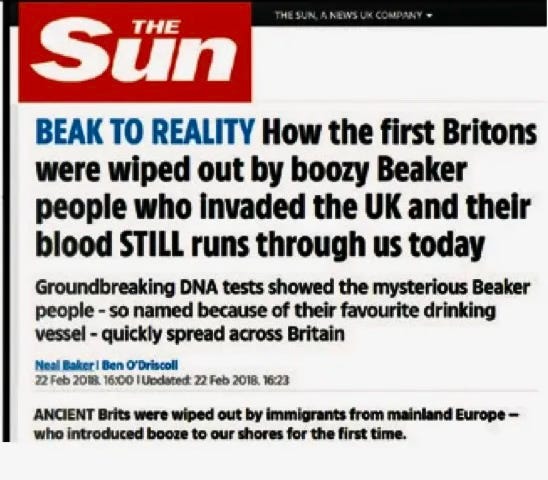
They claimed to have proved 93 per cent of Brits, including almost the entire population of Neolithic Cumbria, were “replaced” 5,000 years ago by a mysterious horde of invaders known as the Beaker People.
This finding, based on the DNA analysis of 400 Bronze Age skeletons led by experts at Harvard University, has become the authorised version of what happened in that period. It is endorsed by authorities ranging from the Natural History Museum to University College London and is often repeated in BBC reports.
But the results which were first published in February 2018 have caused deep puzzlement. If true, the narrative would make nonsense of what British archaeologists have said about Cumbria’s prehistory.
The problem is that the American version of events does not remotely accord with the evidence that the archaeologists are still digging out of the Cumbrian soil.
Nor is there any sign that the “removal” of 93 per cent of the indigenous people had prevented Cumbria’s Celtic culture flourishing as if nothing had happened.
For example, archaeology shows that many unique features of Cumbrian prehistoric life including the building and use of stone circles, cremation burials and farming routines such as the use of drove roads for moving livestock clearly continued uninterrupted into the late Bronze Age and beyond, well after the alleged Beaker invasion.
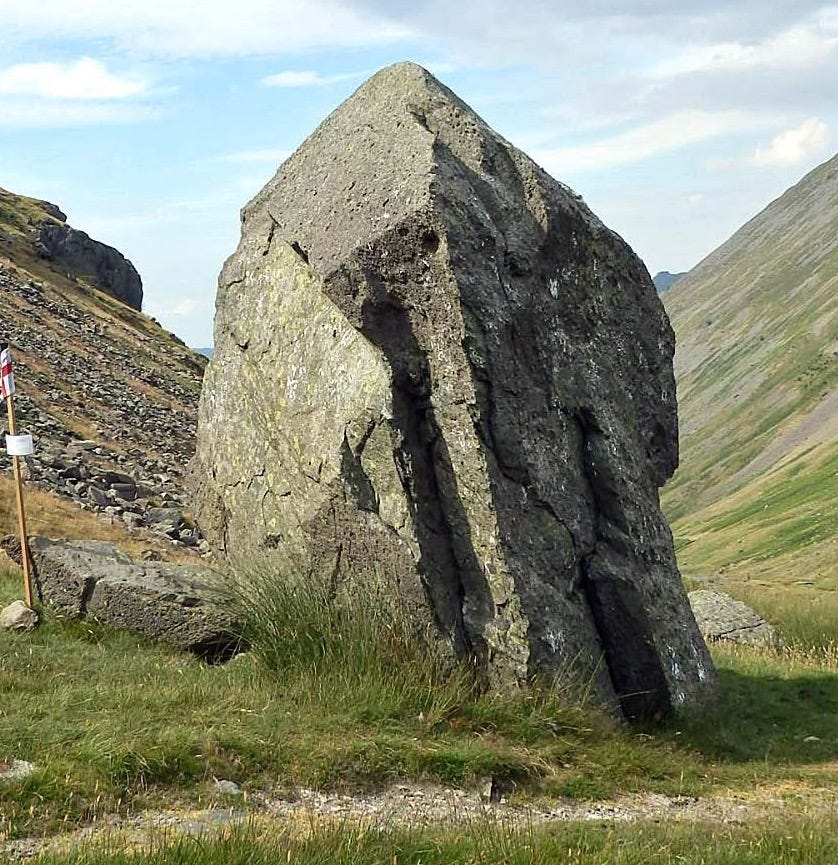
Carved symbols on the Neolithic stone circle known as Long Meg near Penrith indicates the monument continued to be used by locals long after the Beaker people supposedly depopulated Cumbria. And there is another puzzle. Very few Beaker burials have been found in Cumbria.
The places where Beakers have so far turned up include Ewanrigg near Maryport, Shap, Levens, Clifton, Stanton Bridge, Caldbeck, Sizergh Fell, Brougham, Castle Carrock and Waberthwaite.
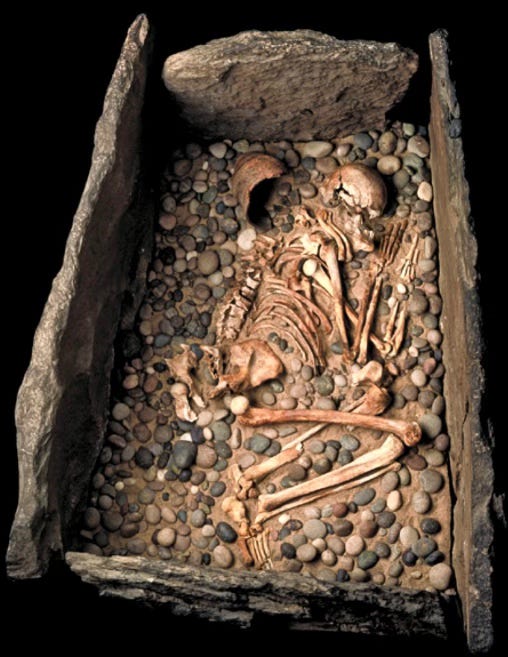
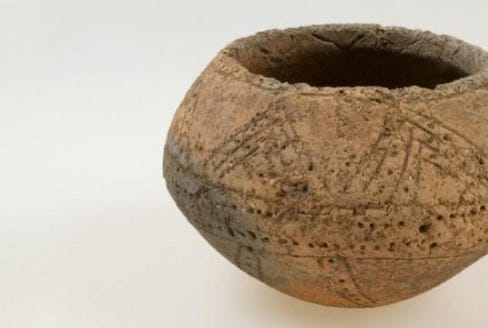
At Ewanrigg two Beaker bodies were found in a gravelly mound beside the site of a dried up river. One skeleton was crouching on his side in a stone coffin or cist. Close by his body were fifteen shards from the belly and neck of a well-fired pottery Beaker drinking cup beautifully decorated with alternate diagonal marks.
In life, the container may have been filled with a heady potion of beer mixed with cannabis. His grave was plundered by tomb raiders long ago. The valuables that he was almost certainly buried with have vanished.
But, in style, the Ewanrigg burial resembled that of the famous Amesbury Archer. The archer was buried in about 2,300 BC, perhaps a century or two before the Ewanrigg person, three miles from Stonehenge.
His body was surrounded by a rich array of precious metal goods and a quiver of arrows.
It seems significant that the Ewanrigg Beaker person was buried as a whole skeleton.
But he was found next to the bodies of 26 cremated individuals buried according to the old Neolithic tradition. Carbon dating tells us they all died in roughly the same period of the Bronze Age, 2460-1520 BC.
The burial found at Ewanrigg near Maryport strongly suggests that the Beaker people were living peacefully alongside their British peers, not, ahem, “removing” them.
The Cumbrian traditions lived on and were not erased, at least at this stage, by the Beaker arrival. Also, inside the Ewanrigg burial mound experts found a pottery tube known as a tuyere; the end of an air pipe which would be attached to a bellows that pumped air into a bronze furnace.
It is a fascinating fact that the furnace pipe was discovered inside one of the Neolithic cremation burials, not in the Beaker burial.
Science tells us that the pipe was put there 630 years after the Beaker bodies were buried. Many academics claim Beaker people brought bronze smelting skills with them.
This Ewanrigg evidence raises serious questions about that. But even if the Harvard version of this story is correct, many archaeologists ask a difficult question:
How could such a tiny number of Beaker people have done away with almost the entire population of Neolithic Cumbria?
The controversial Harvard University findings came from a DNA analysis of 400 Bronze Age skeletons found in prehistoric graves across Europe. Just thirty-seven of them were from burials in Britain.
The research was carried out by an international group of 144 archaeologists and geneticists led by American academics. They said the results showed the gene pool belonging to the British Neolithic farmers were almost entirely replaced by Beaker people who invaded from modern-day Holland in the years after 2450 BC.
The implication was clear: the people who had lived in places like Cumbria for 1,500 years and had built prehistoric monuments such as Castlerigg Stone Circle were almost completely, as newspaper reports put it, wiped out.
But many British archaeologists challenge the Harvard findings, particularly its British “90% replacement” headline which they argue derived from a partial and biased sample, not as a literal description of what happened to every community on the ground. They point out the burials used were heavily drawn from regions where Beaker inhumations are especially visible and well-excavated, notably Wessex-Salisbury Plain and other intensively studied areas, not a random sample of the whole island’s population.
Julian Thomas, Archaeology Professor at Manchester University warned that the Harvard team was making a mistake by taking too literally the results of DNA surveys without weighing other evidence alongside them.
He wrote: “DNA-based models of swift and comprehensive population change sometimes conflict with other aspects of the evidence, as has been noted in the case of the Beaker period in Britain.” However the Americans answered this by saying they compensated for the thin British evidence base by using advanced mathematical techniques.
Paul’s latest book is called Secrets of the Hidden People. You can buy it at Bookends in Carlisle or Keswick and the New Bookshop in Cockermouth or Sam Read in Grasmere.
Alternatively, you can order a copy online here:
https://www.fletcherchristianbooks.com/product/secrets-of-the-hidden-people
